
The Cross-Functional Stakeholder Alignment Playbook
7/17/20263 min read
I've seen every complex product rollout eventually hitting the same wall: the people building it stop talking to each other.
Engineering optimizes for architecture, Design pushes for usability, Experts demand compliance, and Risk Management flags every decision as a potential liability. The product manager sits in the middle, expected to make all of these perspectives converge.
This "playbook", that I drafted from internet knowledge and professional experience, distills cross-functional alignment into repeatable steps that work regardless of industry.
Why Cross-Functional Alignment Breaks Down
Alignment fails because each department operates with a different mental model or definition of what "done" looks like.
Somehow, teams in most companies still work in silos, causing stakeholders to lack a common representation of the high-level product plan. The consequence is predictable: departments pursue independent goals, placing individual priorities above corporate objectives and thus wasting resources. In regulated domains, the gap widens.
There could be four structural challenges that recur: role clarity, harmonization of decision rights, information management, and capability gaps in analytics.
The biggest source of delay is rarely technical complexity; it is ambiguity about who owns which decision and which document is authoritative.
Step 1 — Map Your Stakeholders Before You Need Them
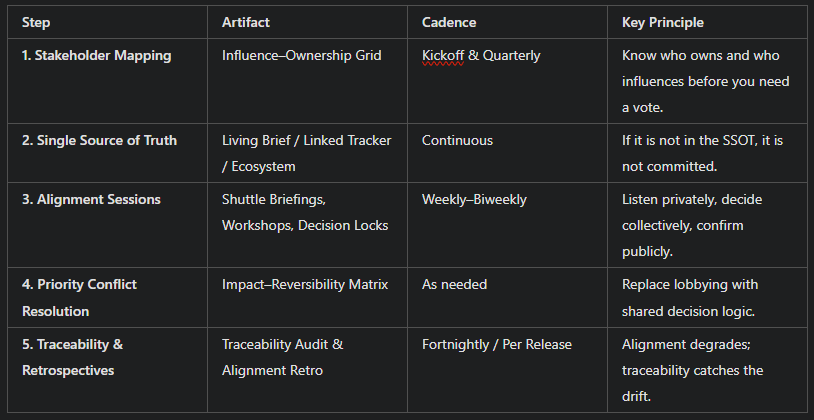
Stakeholder mapping is the first and most under-invested step in any cross-functional initiative. Experienced practitioners use an Influence–Ownership Grid to plot stakeholders on two axes: ownership (responsibility for executing or approving) and influence (the power to shape decisions or scope). This produces four quadrants:
Owners (high ownership, high influence): The core working group. Give them a seat in every planning session.
Gatekeepers (low ownership, high influence): Risk, regulatory, legal. They can block features. Brief them early through lightweight, individual updates.
Builders (high ownership, low influence): Engineers, designers, QA. They execute the work. Protect their capacity by including a representative in scope discussions.
Observers (low ownership, low influence): Interested parties needing awareness. A monthly roadmap digest is sufficient.
Mapping stakeholders early eliminates the pattern of surprise objections late in the cycle.
Step 2 — Build a Shared Single Source of Truth
A single source of truth (SSOT) is not a tool; it is a contract. The contract states: if a decision, risk, or requirement is not recorded here, it does not exist. This replaces scattered discussions with a coherent baseline for communication and traceability. Depending on organizational maturity, an SSOT takes three forms:
Level 1 — The Living Brief: A single collaborative document (Confluence, Notion, Google Docs) containing the brief, requirements, and open questions. It is updated in real time during meetings.
Level 2 — The Linked Tracker: A structured backlog (Jira, Linear) where requirements trace directly to design choices and risk controls.
Level 3 — The Orchestrated Ecosystem: Multiple tools feeding a shared data model. Backlogs, risk registers, and design systems reference common identifiers.
Enforcing the rule that unrecorded decisions are not committed eliminates verbal alignment gaps and cuts down deployment surprises.
Step 3 — Run Stakeholder Alignment Sessions, Not Status Meetings
Most cross-functional meetings fail because they are either passive status readouts or chaotic debates lacking context. Replace them with a three-tier meeting architecture:
Tier 1 — Shuttle Briefings (1:1, 15–30 min): Conduct one-on-one meetings before group sessions to manage expectations, identify individual priorities, and give cautious stakeholders a private channel to raise objections.
Tier 2 — Co-Creation Workshops (group, 60–90 min): Working sessions centered on a single artifact. Project the SSOT on screen, make edits live, and ensure stakeholders actively participate to resolve design features and issues together.
Tier 3 — Decision Lock Meeting (group, 30 min max): A time-boxed session where decisions are confirmed, not debated. Unresolved points are deferred to bilateral follow-ups. A central authority weighs conflicting priorities to make final calls.
Step 4 — Manage Conflicting Priorities with Logic
When departments clash, you need a decision framework faster than consensus and more credible than arbitrary authority. Use an Impact–Reversibility Matrix to categorize choices:
High impact, low reversibility: Architecture choices, regulatory commitments. These require cross-functional sign-off via a Co-Creation Workshop and a Decision Lock.
High impact, high reversibility: UX flows, sprint priorities. Identify the minimum marketable feature to implement first, validate, and iterate.
Low impact, low reversibility: Technical standards. Delegate to the owning team with a brief documented rationale in the SSOT.
Low impact, high reversibility: UI copy, minor interaction patterns. Let the builder closest to the work decide.
When departments block each other, apply a clear escalation path: clarify the constraint in writing, map dependencies in the SSOT, split scope via the minimum marketable feature, and escalate with data to the Decision Lock group if the conflict persists.
Step 5 — Close the Loop with Traceability and Retrospectives
Alignment degrades with every sprint. Two mechanisms keep the execution tight:
Traceability checks: Every fortnight, trace random shipped items backward through the SSOT to ensure the chain from customer need to design decision remains unbroken. This catches undocumented changes before they turn into compliance gaps.
Alignment retrospectives: Once per cycle, review where conflicting priorities were discovered too late and where the SSOT failed to reflect reality. This surfaces communication and language differences before they become blockers.
Final Principle
The path to cross-functional alignment is a systematic practice of making decisions visible, giving stakeholders a channel to be heard before group meetings, and enforcing a single authoritative record of choices. Structures—mapping, the SSOT, meeting tiers, and decision matrices—convert shared intent into coordinated execution.